The Ultimate Guide to Buddhist Deity Mantras: Meaning, Benefits, and Choosing Your Meditation Thangka
Walk into any traditional meditation room or monastery in Nepal, and you will immediately notice the walls are alive with color. These aren’t just decorative pieces; they are sacred thangka paintings. In Vajrayana Buddhism, an authentic tibetan thangka serves as a visual map of the enlightened mind, a blueprint used to ground our focus, clear mental static, and deepen practice.
When you pair the visual precision of a thangka with the spoken vibration of a deity’s mantra, your practice shifts. The space around you transforms into a quiet sanctuary.
In this comprehensive guide, we break down the deeper meanings, syllable-by-syllable translations, phonetic pronunciations, and daily practice methods for the most profound deity mantras. We will also look at the difference between White and Green Tara, explore the rich cultural history of the lotus flower, and answer the most frequently asked questions regarding mantra recitation.
Table of Contents
- Understanding Buddhist Deity Mantras
- The Mahakala Mantra: Protection & Overcoming Obstacles
- The Vajrayogini Mantra: Igniting Wisdom & Swift Transformation
- The White Tara Mantra: Healing, Longevity & Grace
- White Tara vs. Green Tara: Key Differences
- What Does the Lotus Flower Symbolize in Buddhism?
- Choosing and Using Your Thangka
- Frequently Asked Questions (FAQ)
1. Understanding Buddhist Deity Mantras
What makes a deity mantra different from ordinary prayers or basic Buddhist chants? In Western traditions, prayer is often a form of dialogue with a higher power. In Vajrayana Buddhism, however, a mantra is a vehicle of resonance. The word mantra literally translates from Sanskrit as "mind protection" (manas meaning mind, and tra meaning tool or protection).
Every deity represents a specific archetypal aspect of your own innate Buddha-nature. When you recite a mantra, you are not praying to an external god; you are using the science of sound vibration to wake up that specific quality inside your own consciousness.
The syllable structures are designed to stimulate subtle neurological and energetic centers (nadis) within the body. Depending on your current life path, you might choose to work with a protective mantra to establish personal boundaries, a wisdom mantra to spark intuitive clarity, or a healing mantra to restore physical and emotional vitality.
2. The Mahakala Mantra: Protecting Your Space and Overcoming Obstacles
If you are new to Himalayan art, Mahakala can look intimidating. He is depicted as a fierce, wrathful guardian surrounded by a halo of blazing flames. But there is a beautiful truth behind his expression: Mahakala’s intensity is born entirely out of fierce compassion. He isn't angry at you; he is fiercely angry for you-fighting against the ego, pride, mental laziness, and heavy karma that block your inner peace.
Historically, Mahakala originated in ancient Indian traditions as a form of Shiva before being integrated into Vajrayana Buddhism in the 8th century. The classic six-armed form frequently seen in Tibetan art directly represents the perfection of the six paramitas (generosity, ethics, patience, enthusiastic effort, meditation, and wisdom).
The Syllable-by-Syllable Breakdown
To unlock the power of the mantra, we must look at what each sacred sound signifies:
1. Om (ॐ): Represents universal consciousness, the primordial sound of creation, and the alignment of body, speech, and mind.
2. Shri (श्री): Invokes auspiciousness, spiritual prosperity, and divine grace.
3. Mahakala (महाकाल): Maha means great; Kala means time or black. Together, they signify the Great Black One, the ultimate protector who stands outside the limits of time.
4. Hum Hum (हूं हूं): Repeated for emphasis; these syllables forcefully dissolve internal and external obstacles, anger, and negative attachments.
5. Phat (फट्): The sharp, weapon-like sound that cuts directly through illusions, ego, and destructive behavior.
How to Pronounce the Mahakala Mantra Correctly
Phonetic Guide: Ohm Shree Mah-hah-KAH-lah Hoom Hoom Faht
Practice Note: The final syllable "Phat" should sound short and explosive, like the sharp snap of your fingers or a clap of thunder. A common mistake among Western practitioners is pronouncing "Kala" with a very soft, drawn-out English 'a'—ensure the emphasis lands firmly on the second syllable (KAH-lah).
Step-by-Step Daily Practice Instructions
1. Prepare Your Space: Sit in a comfortable, upright meditation posture directly facing your Mahakala Thangka Painting.
2. Center the Breath: Take three deep, slow abdominal breaths to ground your nervous system.
3. Visualize the Guardian: Look into the eyes of the deity, then close your eyes and visualize a ring of protective, golden flames expanding outward from your heart, sealing your room against negative energies.
4. Recite: Using your mala beads, recite the mantra Om Shri Mahakala Hum Hum Phat 108 times. Keep the rhythm steady and confident.
5. Rest in Stillness: Sit in absolute silence for 2 to 3 minutes, letting the protective energy settle into your body.
6. Dedication: Mentally dedicate the peaceful merit of your practice to the safety and liberation of all living beings.
7. Timing Suggestion: Best practiced in the early morning (5:00 AM – 7:00 AM) to set up an energetic shield for your day, or in the evening (6:00 PM – 8:00 PM) to clear away accumulated stress.
3. The Vajrayogini Mantra: Igniting Wisdom and Direct Transformation
Rendered in a vibrant, blazing coral-red, Vajrayoginī is the supreme female Buddha of the Highest Yoga Tantra. She represents absolute freedom, raw untamed wisdom, and the lightning-fast path to realization. As a supreme wisdom dakini, she embodies the ultimate unity of emptiness and bliss. Her lineage became highly prominent within the Chakrasamvara tantra cycles and remains a cornerstone of Tibetan practice.
Vajrayogini teaches a profound psychological shift: instead of telling you to suppress, deny, or run away from your intense human passions, desires, or anger, she shows you how to gather that raw human energy and transform it instantly into spiritual insight.
Choosing Your Version: Short vs. Long Mantra
There are two primary ways to practice her mantra depending on your familiarity and instructional lineage:
1. The Short Mantra: Om Vajrayogini Hum Hum Phat Svaha
2. The Long Mantra: Om Om Om Sarva Buddha Dakiniye Vajra Varnaniye Vajra Vairochaniye Hum Hum Hum Phat Svaha
When to use which? The short version is ideal for daily cultivation, quick focus integration, or when walking and working. The long mantra is utilized during dedicated, seated meditation sessions when you are deeply focused on her complex visual form.
The Syllable-by-Syllable Breakdown (Short Version)
1. Om: The awakening of cosmic purity within your physical body.
2. Vajrayogini: Invoking the Diamond Female Yogi herself, calling her energy into your space.
3. Hum Hum: Pierces through intellectual overthinking and cuts emotional attachments to pride or jealousy.
4. Phat: Shatters the illusions of worldly projections and ego-clinging.
5. Svaha (स्वाहा): Meaning "so be it" or "let the blessings take root." It seals the mantra's energy into your core.
How to Pronounce It Correctly
1. Phonetic Guide: Ohm Vie-rah-yo-GEE-nee Hoom Hoom Faht S'vah-hah
2. Practice Note: Ensure the "Vajra" section sounds like Vie-rah or Vaj-rah with a clean, crisp 'v' sound, avoiding a lazy English 'w' sound.
Step-by-Step Daily Practice Instructions
1. Align Your Posture: Sit with a straight spine. Place your left hand over your right in your lap, thumbs touching.
2. Visual Anchor: Keep your eyes slightly open, resting your gaze gently upon a hand-painted Vajrayogini Thangka. Take in her brilliant red form, her upraised curved knife, and her dance of absolute freedom.
3. Ignite the Fire: As you begin reciting, imagine a small, brilliant red spark at your navel center, burning away all lazy, sluggish, or stagnant thoughts.
4. Recite: Chant either the short or long mantra steadily. Traditional practice suggests completing at least four malas (432 recitations) each day during intensive periods of life transition.
5. Dissolution: At the end of your chanting, imagine the red light expanding to fill your entire being with uncompromising clarity. Sit quietly in this spacious awareness.
4. The White Tara Mantra: Healing, Longevity, and Boundless Grace
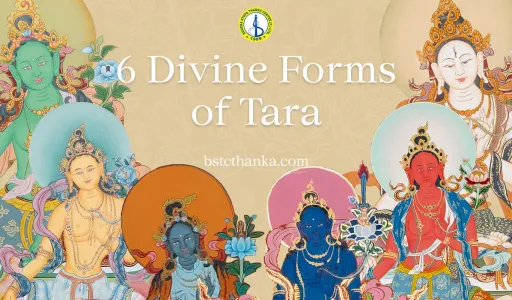
If Mahakala is the protective boundary and Vajrayogini is the transformative fire, White tara is the comforting, steady presence of a mother. Known traditionally as Sitatara, she represents the infinite, unconditional compassion of the enlightened mind.
She is instantly recognizable by the seven eyes across her body—located on her face, the palms of both hands, and the soles of both feet. This symbolizes that she sees the hidden suffering in every corner of the universe and is always ready to offer comfort.
The Syllable-by-Syllable Breakdown
The White tara mantra expands upon the universal Tara chant with specific insertions meant to protect and lengthen life force:
1. Om: Awakens the body, speech, and mind to enlightened energy.
2. Tare: Liberates us from worldly suffering and the cyclic wheel of anxieties.
3.Tuttare: Liberates us from the eight internal fears (pride, ignorance, anger, jealousy, wrong views, attachment, avarice, and doubt).
4. Ture: Liberates us from physical illness and grants spiritual alignment.
5. Mama: Means "mine" or "for me," indicating that you are requesting these blessings to cultivate them within your own life.
6. Ayu (आयु): Invokes long life, vital health, and cellular longevity.
7. Punya (पुण्य): Invokes spiritual merit, ethical purity, and positive karmic alignment.
8. Jnana (ज्ञान): Invokes deep, intuitive wisdom and mental clarity.
9. Pushtim (पुष्टिम्): Means abundance, nourishment, and spiritual enrichment.
10. Kuru (कुरु): An action command meaning "make it so" or "manifest now."
11. Svaha: Seals the healing petition firmly within your heart center.
How to Pronounce It Correctly
1. Phonetic Guide: Ohm Tahr-ay Too-tahr-ay Too-ray Mah-mah Ah-yoo Poon-yah Jyah-nah Poosh-teem Koo-roo S'vah-hah
2. Practice Note: Maintain a soft, gentle, and flowing cadence while chanting this. It shouldn't sound aggressive like a guardian mantra; it should flow smoothly like water.
Step-by-Step Daily Practice Instructions
1. Settle In: Sit comfortably. Place a White Tara Thangka in front of you.
2. Visualize the Light: Close your eyes and imagine a soft, luminescent milk-white light radiating from Tara's forehead, heart, and throat centers, pouring directly into the crown of your head. Feel this soothing light filling your body, repairs tired tissues, and caling your nervous system.
3. Recite: Count 108 recitations on your mala. Keep your breath slow, regular, and deep.
4. Rest: Rest your mind in the profound sense of safety and nurturing energy that follows the practice.
5. Specific Outcomes: Regular practitioners who commit to this practice for a sustained period (such as a 40-day cycle) consistently report lower baseline stress levels, a marked reduction in chronic anxiety, and improved emotional resilience when navigating physical illness.
5. White Tara vs. Green Tara: Key Differences
When studying a thangka painting, beginners often wonder about the relationship between White Tara Green Tara imagery. While both are divine expressions of maternal compassion, they hold distinct roles within your spiritual practice:
| Feature | White Tara (Sitatara) | Green Tara (Shyama Tara) |
|---|---|---|
| Primary Focus | Longevity, physical & emotional healing, serenity. | Swift action, courage, quick protection from fears. |
| Color Symbolism | White represents absolute purity, peace, and stillness. | Green represents the wind element, active energy, and growth. |
| Physical Posture | Seated in the full cross-legged meditative lotus posture (Vajrasana), representing stillness. | Left leg is folded in meditation, while her right leg is extended out, resting on a small lotus base. |
| Symbolic Action | Her posture shows she is a permanent sanctuary of rest. Her seven eyes see all suffering. | Her extended right leg shows she is actively stepping down, ready to leap into action to help you immediately. |
| Best Used For | Long-term physical illness recovery, clearing deep emotional trauma, and cultivating household peace. | Overcoming sudden obstacles, fear during travel, job transitions, and building immediate courage. |
Many practitioners choose to work with both: they invoke Green Tara in moments of sudden crisis or daily life obstacles, and sit with White Tara for deep, restorative healing and long-term lifespan cultivation.
6. What Does the Lotus Flower Symbolize in Buddhism?
Look closely at almost any authentic thangka, and you will spot one universal detail underneath the feet or seat of every single deity: the lotus throne.
The lotus flower meaning serves as a perfect, comforting mirror for our own human lives. A lotus doesn't grow in a sterile environment. It begins its journey deep in the dark, messy, stagnant mud at the bottom of a pond. Yet, it pushes its way up through the murky water, navigating the dark depths, to bloom completely clean, fragrant, and radiant on the surface.
The Four Stages of Growth
The lifecycle of the lotus matches the evolution of a practitioner’s path:
1. The Seed (Potential): Locked deep in the mud, representing our unawakened state, confusion, and heavy everyday problems.
2. The Sprout (Commitment): Pushing upward through the dark water, representing our initial commitment to daily practice and spiritual growth.
3. The Bud (Development): Reaching the surface but still closed, representing the gradual clearing of karma and accumulation of internal wisdom.
4. The Bloom (Enlightenment): Opening completely to the sun, representing an open heart, ultimate clarity, and an awakened mind.
The Meaning of Lotus Colors
In traditional art, the specific color of the flower carries distinct meanings:
1. White Lotus: Represents mental and spiritual purity, absolute peace, and the heart of the Buddhas.
2. Pink Lotus: The supreme lotus, strictly reserved for the historical Buddha, Siddhartha Gautama, and great lineages.
3. Red Lotus: Represents the warmth of the heart, active compassion, love, and emotional transformation.
4. Blue Lotus: Represents the victory of wisdom over the senses, intelligence, and the unfolding of knowledge.
Every time you look at a thangka, seeing a Buddha sitting atop a lotus is a constant visual reminder that your current difficult environment doesn't define your ultimate potential. No matter how messy or heavy things might feel right now, you have the exact same capacity to rise, heal, and open up beautifully.
7. Choosing and Using Your Thangka
Choosing a piece of sacred art isn't a technical checklist; it's an intuitive connection. Don't worry too much about matching the canvas to your home's color scheme or overthinking the iconographic rules. Instead, trust your intuition and ask yourself two simple questions:
1. What energy does my life or home need right now? Do you need strong boundaries and energetic protection (Mahakala), sharp focus and a creative spark (Vajrayogini), or deep rest, healing, and peace (White Tara)?
2. Which painting keeps drawing your eyes back to it? More often than not, you don't choose the deity, the deity chooses you.
Traditional Sacred Placement Guide
Once you bring a piece of traditional art into your space, its placement helps organize your room's energy:
1. Mahakala: Best placed near the main entrance of a home, in an entrance hall, or directly facing your main seating area to establish a secure guardian boundary.
2. White Tara: Ideal for a personal bedroom, a dedicated healing space, or a quiet room where you recover from daily burnout.
3. Vajrayogini: Best kept inside a private meditation room, a creative studio, or an office space where deep focus is required.
4. Mandalas: Hanging a hand-painted Mandala Thangka in a central living room or office organizes the room's energy structure, helps naturally lower stress levels, and brings a sense of universal alignment to everyone who steps inside.
At Boudha Stupa Thangka Center, we have spent years preserving this living tradition right here in Nepal. We work face-to-face with master Newar and Tibetan artists who spend weeks, sometimes months, grinding natural mineral pigments and applying real 24K gold details to a single canvas. This level of devotion ensures that the precise proportions passed down through generations remain pure and fully intact.
8. Frequently Asked Questions (FAQ)
Q: What is the mantra of Mahakala?
A: The primary, widely practiced mantra of the protector Mahakala is Om Shri Mahakala Hum Hum Phat. It is utilized to clear heavy spiritual obstacles, break negative mental loops, and clear stagnant energy out of a living space.
Q: Can anyone chant the Mahakala mantra?
A: Yes, simple recitation of the mantra with a respectful mind and a compassionate motivation is perfectly open to everyone. However, because Mahakala is a highly complex, wrathful deity, advanced tantric visualization practices (sadhanas) traditionally require a formal empowerment (wang) and transmission from a qualified lineage lama. For daily protection and art appreciation, simple recitation is fully safe and beneficial.
Q: Why is Om Mani Padme Hum so powerful?
A: As the mantra of Chenrezig (Avalokiteshvara), the Buddha of Infinite Compassion, Om Mani Padme Hum contains the essence of all the Buddha's teachings in six syllables. It purifies the six realms of existence, transforms negative emotions into their corresponding wisdoms, and resonates directly with the heart center of every living being.
Q: How to chant for Mahakal?
A: To chant for Mahakala, sit comfortably in front of his imagery with a straight spine. Ground your mind by visualizing a protective ring of fire around you. Recite the syllables Om Shri Mahakala Hum Hum Phat with a steady, confident, and rhythmic vocal tone. Focus your mind on cutting through your own ego and self-doubt.
Q: What is the mantra of Vajrayogini?
A: The short daily practice mantra is Om Vajrayogini Hum Hum Phat Svaha. The long mantra used for formal practice is Om Om Om Sarva Buddha Dakiniye Vajra Varnaniye Vajra Vairochaniye Hum Hum Hum Phat Svaha.
Q: Is it good to keep a vajra at home?
A: Yes, keeping a physical ritual vajra (dorje) on your altar or meditation table is highly auspicious. The vajra represents the indestructible nature of reality—like a diamond—and the lightning bolt of sudden clarity that shatters ignorance. It should always be treated with respect and kept in a clean, elevated position.
Q: What is the White Tara mantra for?
A: The white tara mantra benefits center on physical longevity, emotional healing, overcoming vital energy depletion, and calming a highly stressed nervous system. It is traditionally charted for friends or family members who are suffering from long-term illnesses.
Q: How to pray to White Tara?
A: Sit quietly and visualize a soothing, milk-white light radiating from her seven eyes and flowing into your body. Recite her mantra smoothly, with a gentle cadence, intending that her soothing motherly energy brings comfort and healing to your mind and to all beings currently in pain.
Q: Which Tara mantra is powerful?
A: All Tara emanation mantras are completely powerful; the ideal choice depends on your current situation. Green Tara’s mantra (Om Tare Tuttare Ture Svaha) is unmatched for swift obstacle removal and building immediate courage. White Tara’s mantra is the definitive choice for deep healing, rest, and cultivating long-term vitality.
Take your time looking through our sacred collections to find a piece that speaks clearly to your path:
I. Browse Our Protection & Guardian Paintings (Mahakala)