



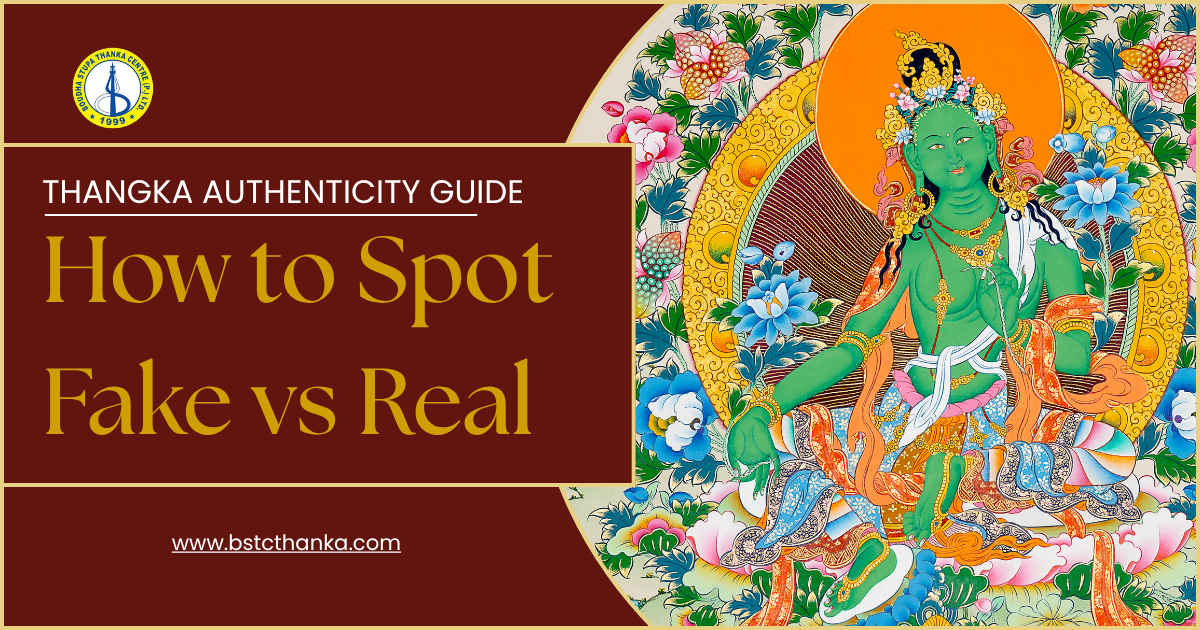
Thangka Authenticity Guide: How to Spot a Fake vs a Real Thangka Painting
If you've ever searched "how to tell if a thangka is real" or "authentic Tibetan thangka painting," you've probably found conflicting answers. Here's the truth: no thangka is 100% authentic by every single criterion. Authenticity isn't a yes/no switch — it's a spectrum. Once you understand where a piece sits on that spectrum, you can buy with confidence and pay a fair price for what you're actually getting.
This guide breaks down the four authenticity tiers of thangka art, plus a practical, step-by-step method to evaluate any thangka painting for sale — whether you're buying in Kathmandu, Boudhanath, or online.
The Authenticity Spectrum: 4 Tiers of Thangka Painting
Understanding thangka price ranges starts with understanding what you're actually paying for. Here is the real breakdown.
Tier 1: Commission-Level Thangka (₹50,000–₹500,000+)
This is the gold standard of authentic hand-painted thangka art.
- Iconography: Fully accurate, following exact specifications given by a lama or teacher (deity proportions, mudras, attributes, and symbolic colors all correct per traditional iconometric grids).
- Style: Stylistically consistent from start to finish — painted by a single master artist over 6–24 months.
- Materials: Genuine mineral pigments (malachite, azurite, cinnabar), real gold leaf gilding, and hand-prepared cotton canvas.
- Age: Usually 0–24 months old, freshly commissioned. Buyers typically receive commission documentation, artist details, and consecration information.
This tier is what serious collectors, monasteries, and practitioners look for when searching for a custom thangka commission or master thangka painter in Nepal.
Tier 2: Gallery Master Work (₹20,000–₹100,000)
This is the most common tier found in reputable thangka galleries near Boudhanath Stupa.
- Iconography: Mostly accurate to traditional standards, occasionally with minor simplifications.
- Style: Stylistically consistent — one artist, one vision.
- Materials: Genuine mineral pigments and gold leaf, though sometimes blended with quality synthetic binders for durability.
- Age: Typically 5–30 years old, often from established ateliers with a traceable lineage of master painters.
If you're searching for where to buy a real thangka in Kathmandu, this tier offers the best balance of authenticity, artistry, and price.
Tier 3: Studio Production Thangka (₹5,000–₹25,000)
Iconography: Attempted but simplified — proportions may be slightly off from classical iconometric standards.
Style: Semi-consistent, often because multiple artists work on one piece (one does outlines, another does shading, another does detailing).
Materials: A mix of synthetic and mineral pigments; gold paint instead of gold leaf.
Age: Recently made, produced for steady tourist and retail demand.
These are common in souvenir thangka shops and are honest, decorative pieces — as long as they're priced and sold as such.
Tier 4: Commercial Mass-Produced Thangka (₹500–₹5,000)
This is where most fake thangka paintings and mass-market reproductions fall.
- Iconography: Often inaccurate — incorrect arm counts, missing attributes, or wrong hand positions (mudras).
- Style: Inconsistent — assembly-line production, sometimes even printed or stenciled rather than hand-painted.
- Materials: Synthetic acrylic pigments on machine-made or acrylic-primed canvas.
- Age: Made within the last 1–3 years, frequently artificially aged thangka to be sold as "antique."
Knowing this tier exists is the single best defense against thangka scams targeting tourists.
Practical Criteria for Evaluating Thangka Authenticity
Whether you're standing in a shop or browsing a thangka for sale online, use this four-step method.
Step 1: Check the Iconography
This is the most reliable thangka authentication method because iconography follows strict, documented rules — it isn't a matter of opinion.
- Find a reference image from a monastery website or academic/museum source (this is one reason institutions like the Rubin Museum or established monastery archives are useful references).
- Compare: arm count, number of faces, attribute (implement) positions, body color, crown type, and seated posture.
- If you spot 8–10 discrepancies from the reference, the piece is decorative, not iconographically functional — meaning it isn't suitable for shrine use or ritual practice, even if it's beautifully painted.
This step alone answers the most common buyer question: "how do I know if my thangka deity is painted correctly?"
Step 2: Evaluate Style Consistency
Ask yourself: do all the brushstrokes look like they came from one hand?
- Consistent line weight throughout the piece (thin, confident outlines vs. shaky, uneven ones)
- Even proportion handling across the whole composition
- Uniform color blending and shading technique
Inconsistent brushwork is one of the clearest signs of mass-produced thangka art made by multiple low-paid workers on an assembly line, rather than a single traditional thangka master painter.
Step 3: Look at Condition Patterns — Real vs. Artificial Aging
This step separates a genuine antique thangka from an artificially aged fake thangka.
Signs of real, natural aging:
- Gold shows wear specifically in high-contact areas (edges, hands that were touched during rituals)
- Pigment fades unevenly — blue pigments (historically less stable) typically fade faster than reds
- Varnish yellows gradually over decades and dust settles naturally into surface cracks
Signs of artificial aging (a major red flag):
- Uniform fading across all colors at the same rate (real pigments don't degrade evenly)
- Gold leaf that looks suspiciously pristine while the canvas looks aged — a mismatch that shouldn't occur naturally
- Zero dust accumulation in cracks or seams, which can indicate the piece was recently "cleaned" or artificially distressed to fake age
Learning to spot artificial aging in thangka paintings is one of the most valuable skills for any serious buyer or collector.
Step 4: Trust Your Eye
After the technical checks, the simplest test still matters: if something looks cheap, it probably is.
Skillful work is visible to the naked eye. An artist who invested 6+ months into a single hand-painted thangka shows that investment in every fine detail — the steadiness of the linework, the precision of the shading, the confidence of the composition. This instinct, once trained by the steps above, becomes one of the most reliable tips for buying an authentic thangka.
Frequently Asked Questions
Q1: How can I tell if my thangka is real or fake?
Check four things: iconographic accuracy (arm count, mudras, attributes matching a reference source), style consistency (one artist's hand throughout), material quality (mineral pigments and real gold leaf vs. synthetic/acrylic), and aging pattern (uneven natural fading vs. uniform artificial aging).
Q2: What is the price range for an authentic hand-painted thangka?
Genuine hand-painted thangkas typically range from ₹20,000 to ₹500,000+, depending on the tier — gallery master work starts around ₹20,000, while a fully custom commission-level piece can exceed ₹500,000.
Q3: Is a cheap thangka (under ₹5,000) always fake?
Not necessarily fake, but it's almost always Tier 4 — a commercial, mass-produced piece using synthetic pigments and simplified iconography. It can still be a nice decorative souvenir, just not a ritual-grade or investment piece.
Q4: What materials are used in a genuine thangka painting?
Authentic thangkas use natural mineral pigments (like malachite, azurite, and cinnabar), real gold leaf, and hand-prepared cotton canvas — as opposed to synthetic acrylic paints and gold-colored paint used in mass production.
Q5: How do I know if a thangka's aging is real or artificial?
Real aging shows uneven fading (blue fades faster than red), gold wear concentrated on high-touch areas, and dust settled naturally in cracks. Artificial aging shows uniform fading, suspiciously pristine gold on an "aged" canvas, and no dust in the cracks.
Q6 :Does an inaccurate thangka mean it's low quality or fake?
Not always "fake" — but iconographic errors (wrong arm count, wrong attributes) mean the piece is decorative rather than functional for shrine use or ritual practice, which affects both its authenticity tier and value.
Q7: Where is the safest place to buy an authentic thangka in Nepal?
Established galleries near Boudhanath Stupa with a traceable history of master artists (with documented lineage and commission records) are generally the safest source for Tier 1–2 authentic thangkas.
Final Thoughts: Buying With Confidence
There's no shame in owning a Tier 3 or Tier 4 thangka if it was bought and priced honestly as a decorative piece. The real risk lies in paying Tier 1 or Tier 2 prices for a Tier 4 painting — which is where most thangka buying scams happen. Use this four-step framework, ask questions about the artist and materials, and you'll be equipped to evaluate any Tibetan Buddhist thangka painting with real confidence.
👉 Back to the main guide