



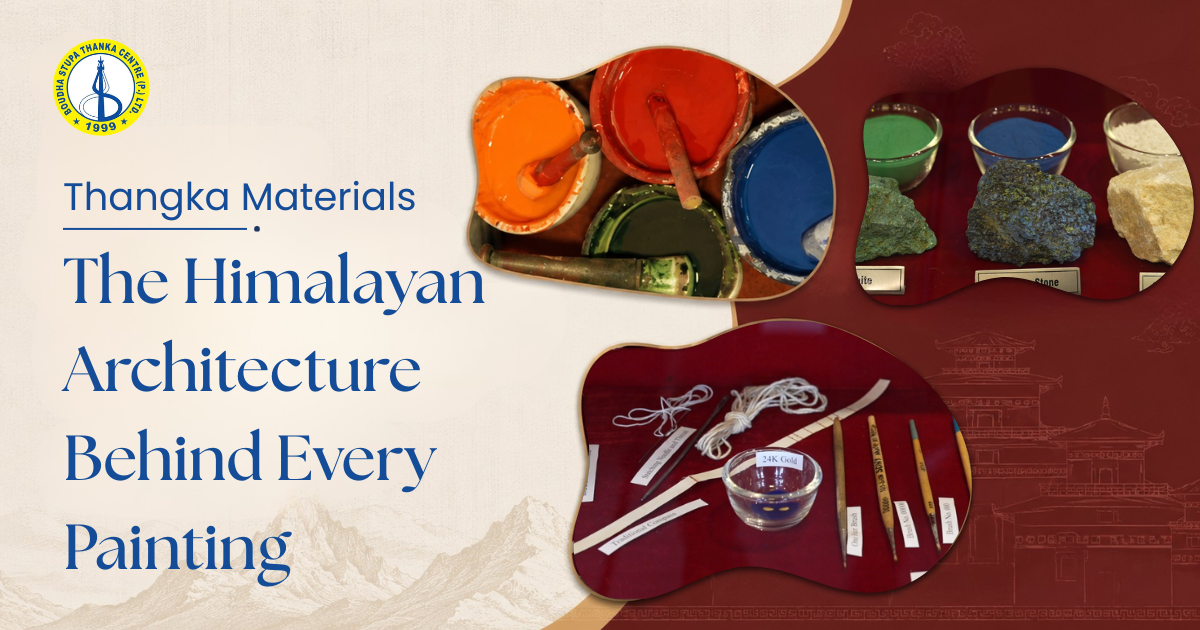
Thangka Materials: The Himalayan Architecture Behind Every Painting
You cannot understand a thangka by looking at it alone. You must understand what it is built from.
A thangka is not stretched canvas from a Western art supply store. It is a layered architecture—cotton soaked and beaten, minerals ground from stone, animal glue prepared by hand, gold leaf burnished until it becomes part of the weave itself. Every material choice carries centuries of knowledge about how to preserve sacred imagery in the mountains.
At Boudha Stupa Thangka Center, we work with these materials daily. We've sourced them from the same valleys for over twenty years. This is what we've learned.
The Canvas: Cotton, Preparation, and the Rabbat Ritual
Why the canvas matters more than the paint.
A Western artist stretches cotton duck on wooden bars, primes it with acrylic gesso, and paints. This method fails for thangkas. Here's why: acrylic primer creates a sealed, plastic-like surface. Buddhist mineral pigments—especially lapis, malachite, and cinnabar—need slight absorbency to bond properly. When humidity shifts in the Himalayas (and it always does), sealed canvas cracks. The paint flakes. The thangka fails.
Authentic thangka canvas breathes. It accepts pigment, ages with flexibility, and survives humidity swings that would destroy modern preparations.
The Correct Materials
Real thangkas use cotton-linen blends or cotton-silk weaves, not cotton duck. The weave is tight but open—not sealed. The texture is almost like linen, with a slight grain.
Why the difference matters: Cotton-silk allows mineral pigments to settle into fiber. They bond mechanically, not chemically. When humidity rises, the canvas expands; when it falls, it contracts. The pigment moves with it. Modern acrylic-primed canvas is rigid and brittle—it cracks instead.
The Preparation Ritual: Rabbat (रब्बत)
Rabbat is a paste made from animal glue (hide glue) and chalk (or sometimes crushed bone). This is not a shortcut. This is the foundation.
The process takes 10–14 days:
- Raw canvas is soaked in water, then dried completely. This opens the weave.
- First coat of rabbat is applied with a brush, working the paste into the fibers. The canvas is then hung to dry for 24–48 hours in controlled conditions (not direct sun, which warps the weave).
- First sanding The dried rabbat creates a chalky surface. Artists sand this lightly with fine sandstone or modern fine-grit paper. The goal is smoothness, not polish.
- Second coat of rabbat Applied more heavily. Another 24–48 hour dry.
- Second sanding Finer than the first. The surface now has a subtle tooth—enough for pigment to grip, not enough to be visible.
- Third coat of rabbat This is the finish layer. It's applied thinner, and the drying is watched carefully. Too much rabbat = pigment slides off later. Too little = absorbency is uneven.
- Final sanding Very light. The canvas now has a matte ivory finish and a surface that feels like old linen.
At BSTC, we use rabbat prepared by hand from hide glue and chalk. The ratio matters: too much glue makes the surface inflexible; too much chalk makes it powdery. We've calibrated it over twenty years.
Regional variations reveal expertise:
- Tibet (high altitude, cold winters): Artists add yak butter to the glue mixture. The butter prevents cracking when temperatures drop below freezing. A thangka prepared with yak butter will age differently than one without—more flexibly in cold, less prone to the rigid brittleness that kills old paintings in heated rooms.
- Nepal (humid valleys): Canvas is beaten more aggressively before rabbat application, opening the weave further. Later, a shellac varnish is applied more heavily (see Varnishes section). The strategy: maximize absorbency in preparation, then seal with varnish. This works in humid climates where moisture is the enemy.
Mineral Pigments: Color as Spiritual Property
A Buddhist thangka's palette is not arbitrary. Each color is tied to a Buddha family, a direction, a wisdom quality. The pigment itself carries meaning.
The Four Main Pigments
Lapis Lazuli (Ultramarine Blue)
- Color: Deep, luminous blue that shifts slightly with light angle. Real lapis has tiny gold flecks (pyrite inclusions).
- Symbolism: Akshobhya Buddha, the Immovable One. East direction. Mirror-like wisdom.
- Cost: $150–400 per gram. A single large thangka might use 10–20 grams.
- Authentication note: If a thangka is priced at $500 and advertises "genuine lapis," it's synthetic. Synthetic ultramarine is chemically identical to real lapis and costs $1–2 per gram. We use synthetic lapis at BSTC for most commissions and say so openly. The color is the same. The price is honest.
- Aging: Real lapis darkens imperceptibly over centuries. Synthetic lapis is stable.
- Application: Ground into fine powder, mixed with hide glue (not water). Applied in thin, translucent layers. The luminosity comes from layering, not thickness.
Cinnabar / Vermilion (Red)
- Color: Bright red, slightly warm. The most visually striking color in classical thangkas.
- Symbolism: Vajra family. Compassion and power intertwined.
- Chemistry: Mercury sulfide (HgS). Real cinnabar is toxic in powder form and was used by traditional artists who understood the risk.
- Modern practice: Most thangka artists now use synthetic cinnabar or red ochre alternatives. Same reason—safety and price.
- The authenticity problem: Cinnabar darkens if mixed with certain oils or binders. Tibetan artists developed specific lacquer ratios to prevent this. If you see a old thangka with muddy, darkened reds, the artist either used the wrong binder or the painting was exposed to heat.
- BSTC practice: We use red ochre for most work and reserve synthetic cinnabar for high-commission pieces where the collector specifically requests traditional color palette.
Malachite (Green)
- Color: Vivid, slightly cool green. Complex. Doesn't look flat.
- Symbolism: Amitabha Buddha (sometimes), Tara. Associated with healing and protection.
- Chemistry: Copper carbonate. Ground into powder and mixed with glue.
- Aging behavior: Malachite reacts slowly to humidity and oxygen. In thangkas from 1800s Kathmandu (unsealed, exposed to monsoon moisture), malachite areas show a blue-shift—the green gradually changes toward blue-green or teal over 150+ years.
- Prevention: This is why varnish exists. A sealed thangka with malachite will not shift.
- Observation: If you see an old thangka where the greens look slightly blue, you're looking at authentic malachite aging. It's not damage. It's time.
Gold Leaf
- Format: 24-karat gold, hammered into sheets so thin light passes through them. The traditional standard.
- Application: Laid on a tacky adhesive (often a mix of glue and plant resin), then burnished with smooth stones until it fuses with the adhesive layer.
- Visual property: Lustrous, with depth. The reflectivity changes with light angle and viewing distance.
- Durability: Gold doesn't fade. It can tarnish if exposed to sulfur compounds (air pollution in industrial cities), but this is rare and reversible.
- Cost: $50–150 per sheet, depending on size.
Gold Paint (Powder + Binder)
- Format: Gold powder (often 22-karat or lower) mixed with glue or resin.
- Visual property: Flatter than leaf. Can look metallic or dull depending on pigment size and binder.
- Aging risk: If the binder is wrong or the powder is impure, gold paint can oxidize (turn greenish-brown) over 20–30 years. This happens mostly with cheap acrylic-based gold paints.
- Duration: Quality gold paint stays bright for 50+ years. Poor gold paint degrades in 15–20.
- BSTC advice: Ask the seller directly: "Is this gold leaf or gold paint?" If they're evasive, the answer is probably inferior gold paint. At BSTC, we use gold leaf for urna marks and deity halos, gold paint for background details.
Pigment Application: The Rule of Layers
Buddhist pigment work follows one principle: build color through translucent layers, never opaque thickness.
A blue area of a thangka is not painted blue once. It is:Base coat (light blue or gray underpainting)
- Second coat (medium blue)
- Third coat (full lapis blue)
- Highlight coat (diluted lapis, almost transparent, for luminosity)
This creates depth. The color seems to glow from inside the painting, not sit on top of it. This is the difference between a $300 thangka and a $3000 thangka—not the material, but the patience.
Varnish: Invisible Architecture, Massive Impact
Most collectors never think about varnish. It is the most important material nobody sees.
Varnish is a protective coating applied after the painting is complete. It seals the pigments, protects against moisture, and defines how the thangka ages.
Traditional Varnish: Shellac
What it is: Resin secreted by the lac beetle, dissolved in alcohol. It's been used in Asia for over 1000 years.
Application: Brushed or sprayed onto the finished painting in 1–3 coats. Dries to a hard, glossy finish.
Aging behavior: Shellac yellows gradually. This is not deterioration—it's predictable. A varnished thangka from the 1970s will have a gentle golden warmth by 2050. The aging is beautiful if you understand it.
Timeline: Yellowing begins within 5–10 years, not 100. This is important. Collectors who expect varnished thangkas to stay "pure" are mistaken. Traditional shellac varnish is supposed to patina.
Protection: Shellac seals out humidity extremely well. In Nepal's monsoon, a shellaced thangka survives. An unvarnished one does not.
Cost: $5–15 in materials per thangka.
Modern Alternatives: UV-Resistant Acrylic Varnish
What it is: Polymer-based varnish designed not to yellow.
Advantage: Theoretically stays clear indefinitely.
Disadvantage: Can yellow unpredictably after 30–50 years if the formulation is poor. Also, acrylic varnish is rigid. When humidity shifts, it doesn't flex with the canvas. Over time, it can separate or crack.
BSTC practice: We offer both options. If a collector wants traditional aging, we use shellac. If they want to minimize yellowing, we discuss acrylic with clear expectations.
The No-Varnish Choice
Some contemporary thangka artists skip varnish entirely, leaving the painting matte and unprotected.
Advantages:
- The painting looks softer, less glossy.
- No yellowing.
Disadvantages:
- The thangka is vulnerable to humidity, dust, and UV damage.
- Pigments fade faster.
- In humid climates (Nepal, Tibet), an unvarnished thangka will deteriorate within 10–20 years.
- Best for: Dry climates (high-altitude Tibet, parts of the American West). Not suitable for coastal regions or monsoon areas.
Glue: The Forgotten Essential
All traditional pigments are mixed with glue, not water.
Hide glue (animal-based):
- Made by simmering animal bones and connective tissue until collagen dissolves. Cooled into a gel, then dried into pellets.
- Mixed with water to activate (usually 1:3 ratio—one part glue, three parts water, heated gently).
- Traditional, flexible, reversible.
- Aging: Hide glue becomes more brittle over 100+ years if exposed to heat and low humidity (dry climates). In stable conditions (temples, homes in Nepal), it remains flexible.
Yak butter + hide glue (high-altitude variant):
- Used in Tibet and high-altitude Nepal.
- The butter prevents the glue from drying completely rigid when frozen.
- A thangka prepared this way has different aging characteristics: it stays more flexible in extreme cold.
Acrylic binders (modern):
- Faster, easier, irreversible.
- Acrylic binders can crack and separate if humidity fluctuates.
- Not recommended for traditional thangkas, though they're used in commercial pieces.
BSTC standard: We use hide glue prepared from traditional methods. We source bones from local butchers in Kathmandu, prepare the glue ourselves, and test each batch. It takes more time than buying commercial glue, but the aging is predictable and the result is reversible (a conservator can clean and restore it if needed).
How to Authenticate Materials: Questions to Ask
When buying a thangka, ask these questions directly. The answers tell you everything.
1. "Is the canvas cotton-silk blend or acrylic-primed canvas?"
- Cotton-silk blend = traditional preparation.
- Acrylic primer = commercial production.
2. "What is the gold—leaf or paint?"
- Gold leaf = more expensive, more lustrous, doesn't tarnish.
- Gold paint = cheaper, can oxidize if poor quality.
3. "Is the lapis real or synthetic?"
- If real: the price should reflect $10–50 in materials alone.
- If synthetic: the seller should say so. Synthetic is fine—it's chemically identical.
4. "What pigments are used—mineral or acrylic?"
- Mineral (lapis, malachite, cinnabar) = traditional.
- Acrylic = commercial, fades faster, modern safety standard.
5. "Is there varnish, and if so, what kind?"
- Shellac = traditional, yellows predictably, ages beautifully.
- Acrylic varnish = modern, may yellow unpredictably.
- No varnish = vulnerable, requires dry storage.
6. "How long did preparation and painting take?"
- Less than 2 weeks = commercial production (canvas prep is rushed).
- 4–8 weeks = semi-traditional (canvas properly prepared, painting careful).
- 8+ weeks = high-commission traditional work (hand-mixed pigments, multiple layers, burnished gold).
The Material Hierarchy: What Matters Most
Not all materials are created equal. Here's what actually affects a thangka's longevity and beauty.
Most important (in order):
- Canvas preparation (rabbat). A well-prepared canvas will outlive poor pigments. A poorly prepared canvas will destroy even the best pigments. BSTC spends 2 weeks on this step alone.
- Pigment-to-glue ratio. The pigment is only half the story. If the glue is wrong, the pigment fails. Our master painter Purna Lama adjusts the ratio by feel—he can tell by the viscosity if it's correct.
- Varnish. Seals everything. Determines how the thangka ages. Critical in humid climates.
- Gold type (leaf vs. paint). Matters for visual impact and durability, but less critical than the above three.
- Pigment quality (real vs. synthetic). Matters mostly to the artist and the collector's philosophy. Chemically, synthetic lapis is identical to real.
BSTC's Material Standards
At Boudha Stupa Thangka Center, established 1999, we follow these standards for every thangka we produce:
- Canvas: Cotton-silk blend, prepared with rabbat over 10–14 days using hide glue and chalk sourced locally.
- Pigments: Mineral pigments (lapis, malachite, cinnabar) where traditional. Synthetic pigments where safety and sustainability are priorities. All mixed with hide glue prepared in-house.
- Gold: Gold leaf (24-karat) for sacred elements (urnas, halos, mandalas). Gold paint for secondary details.
- Varnish: Traditional shellac (will yellow gradually, as it should) or UV-resistant acrylic (if the collector requests minimal aging). Each thangka comes with full disclosure of varnish type.
- Timeline: 4–12 weeks, depending on scale and complexity. Our 300+ artists each follow this standard.
Our climate-controlled three-story building maintains stable humidity (50–55%) and temperature (18–22°C). This is where the paintings live while they're being made. It's why they survive.
The Final Truth About Materials
A thangka is not made with expensive things. It is made with correct things.
Expensive lapis doesn't matter if the canvas is wrong. Expensive gold leaf is wasted on a painting that will crack. Expensive pigments fail if the glue is off by one part in the ratio.
What matters is understanding why each material was chosen, how it ages, and what it does in the Himalayan climate. A thangka made with patience, knowledge, and locally-sourced materials will outlive one made with the most expensive Western supplies applied in ignorance.
This is why we've been here since 1999. Not because we have the best paints. Because we understand the architecture.
Have questions about materials? Come visit us at BSTC near Boudhanath Stupa, Kathmandu. We'll show you how it's done.
.png)